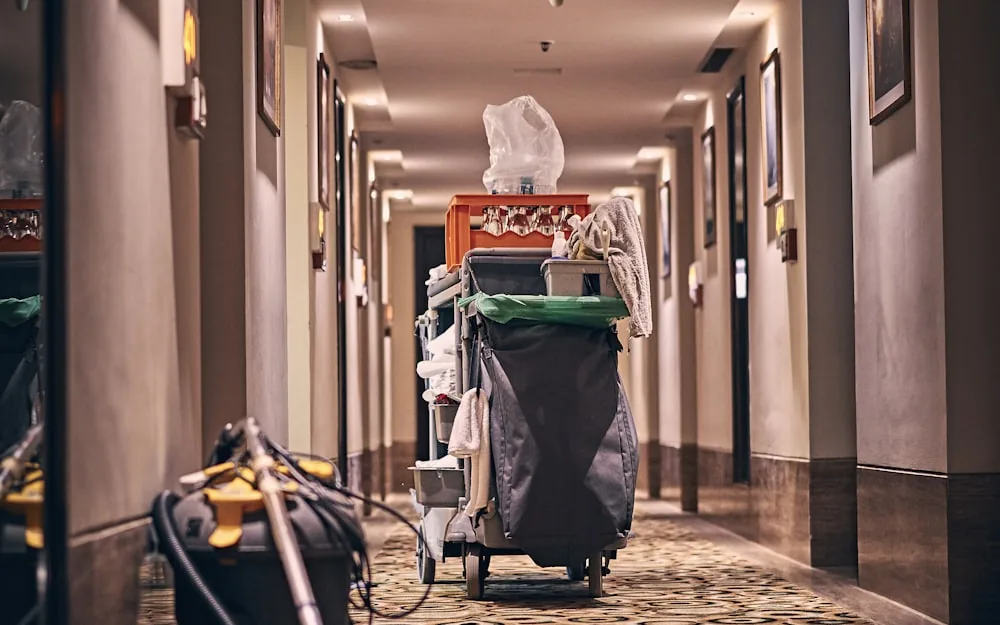
If you let a house in multiple occupation in Nottingham, keeping the communal areas clean and in repair is your responsibility as licence holder, not your tenants'. That holds even when the tenancy agreement says otherwise, because a licence condition sits above a private agreement between you and a tenant.
Nottingham has one of the largest concentrations of shared housing in the country, driven by two universities and a long-established private rented sector across NG7, NG1 and the belt out toward Beeston. It also has an unusually wide licensing footprint. Getting the cleaning arrangement wrong is one of the more avoidable ways to fail an inspection.
The short version
- Communal area cleanliness is a licence holder responsibility. You cannot contract out of it in the tenancy agreement.
- Mandatory HMO licensing applies across England to properties with five or more occupiers forming more than one household. Councils can also run additional and selective schemes covering smaller properties.
- Nottingham City Council operates licensing schemes beyond the mandatory minimum. Check your specific street, because the boundaries do not follow postcodes.
- Inspectors look at kitchens, bathrooms, hallways, stairs and bin stores, in roughly that order.
- Cleaning is also a fire safety issue: a cluttered escape route is a licence problem long before it is a hygiene one.
What the law actually requires
Licensing sits under the Housing Act 2004. Mandatory HMO licensing applies in England where a property is occupied by five or more people forming more than one household and sharing amenities such as a kitchen or bathroom. There is no storey threshold any more; that was removed in 2018.
Alongside mandatory licensing, a council can introduce additional licensing for smaller HMOs and selective licensing covering all private rented properties in a designated area. Nottingham has used both, and the designations are reviewed and redrawn periodically. That matters practically: two identical terraces on adjoining streets can fall under different schemes.
The management standards themselves come from the Management of Houses in Multiple Occupation (England) Regulations 2006. Those regulations put duties on the manager, which in most cases means the landlord or the letting agent. Among them: keeping common parts clean, in good repair and free from obstruction, and keeping the property's installations in working order.
Who cleans what
This is where most disputes start, so it is worth being unambiguous.
| Area | Whose job |
|---|---|
| Individual bedrooms | The tenant occupying it |
| Shared kitchen, day to day | The tenants, by arrangement between them |
| Shared kitchen, deep clean and appliances | The landlord, in practice |
| Bathrooms, day to day | The tenants |
| Bathrooms, descaling, mould and sealant | The landlord |
| Hallways, stairs, landings | The landlord |
| Bin store and outside space | The landlord |
| Extractor filters and ventilation | The landlord |
You can ask tenants to keep the kitchen tidy, and most agreements do. What you cannot do is treat that as discharging your own duty. If an inspector finds a communal hallway full of boxes and a kitchen extractor clogged with grease, the finding is against you.
The pragmatic answer that most Nottingham HMO landlords arrive at is a scheduled communal clean, fortnightly or monthly depending on occupancy, covering the hall, stairs, landing, bathrooms and the kitchen surfaces and floor. It costs less than one failed inspection and it removes the argument entirely.
What inspectors look at
From how these visits tend to run, attention concentrates in a predictable order.
Escape routes first. A hallway or staircase used for storage is both a fire risk and a management regulations breach. Bicycles on a landing, bin bags on stairs and boxes under a fire door are the recurring finds. This is the item most likely to produce enforcement rather than advice.
The kitchen. Extractor filters, the oven, behind and under appliances, and the state of the bin area. Shared kitchens generate roughly twice the airborne grease of a single household kitchen, because several people cook separately across a longer daily window.
Bathrooms. Mould in sealant rather than on it, limescale on screens and shower heads, and whether the extractor actually extracts. Nottingham sits at the harder end of the water scale, so scale accumulates faster here than in a soft water area. Check your own postcode on Severn Trent's water quality checker.
Ventilation generally. A shared house with sealed windows and a dead extractor produces condensation, then mould on window reveals and external wall corners. That is a repair and management issue rather than a cleaning one, and cleaning it repeatedly without fixing the ventilation is money burned.
Bin storage. Refuse arrangements appear explicitly in the management regulations. Overflowing bins in a front yard is a straightforward finding.
Turnarounds in a student HMO
Nottingham's academic tenancies end within a fortnight of each other, which compresses the entire year's turnaround work into late June and July. Two things follow from that.
The first is that capacity genuinely runs out. Every cleaning company in the city is committed by the third week of June. Booking in May is not cautious, it is normal.
The second is that the check-in inventory you create in that window is the document every deposit claim next June will be judged against. Cleaning is the single largest cause of deposit deductions in the UK, at 29.38% of all claims according to Deposit Protection Service data reported in 2026, and a vague inventory cannot support a claim. Photograph the oven interior, the shower screen, the window tracks and inside every cupboard, and date it.
What it costs
Communal cleaning in a shared house is priced on the number of bathrooms and the kitchen, not the bedroom count, because that is where the hours go.
| Property | Communal clean | Typical frequency |
|---|---|---|
| 4 bed HMO, one bathroom | 1.5 to 2 hours | Fortnightly |
| 5 bed HMO, two bathrooms | 2 to 3 hours | Fortnightly |
| 6 bed HMO, two bathrooms | 3 hours | Weekly or fortnightly |
| 8+ bed, three bathrooms | 4 hours plus | Weekly |
A full end of tenancy clean between academic years is a separate job again, and closer in scope to a deep clean because a year of shared occupancy leaves the annual jobs untouched.
Practical arrangements that work
- Put the communal clean in the tenancy pack. Tenants who know a cleaner comes on a Tuesday keep the hall clearer than tenants who do not.
- Keep bedrooms out of scope. Cleaning tenants' rooms creates access and privacy complications and is rarely worth it.
- Use a key safe and a fixed slot. Lockouts in an eight-bed house are otherwise routine.
- Replace mouldy sealant rather than cleaning it repeatedly. Thirty minutes with a sealant gun beats four visits with a brush.
- Change extractor filters on a schedule rather than when someone notices the smell.
- Photograph the communal areas monthly. If a licensing officer ever asks how you manage the property, a dated record answers it in one email.
Frequently asked questions
Does my HMO need a licence? If five or more people forming more than one household share amenities, mandatory licensing applies anywhere in England. Below that, it depends on whether your street falls inside a Nottingham additional or selective licensing designation. Check with Nottingham City Council for the specific address rather than assuming from the postcode.
Can I make tenants responsible for communal cleaning in the agreement? You can ask them to keep it tidy, and it is sensible to. It does not transfer the licence holder duty, and an inspector will not accept it as an answer.
How often should communal areas be cleaned? Fortnightly is the common arrangement for a four to six bed house. Weekly once you are above six occupants or two bathrooms.
Is the landlord responsible for cleaning tenants' bedrooms? No. Bedrooms are the occupier's own space and are judged against their own tenancy agreement at check-out.
What happens if I fail an inspection? Councils generally start with improvement notices and timescales rather than penalties. Repeated or serious failures, particularly around fire escape routes, can lead to financial penalties and affect your fit and proper person status as a licence holder.