Exterior windows need cleaning every four to eight weeks in most UK settings, more often near a main road or the coast, less often in a sheltered rural location. Interior windows need doing two to four times a year for most homes.
The interior is the one people underestimate. Condensation, cooking residue and dust build a film that reduces daylight noticeably, particularly in winter when there is little daylight to lose.
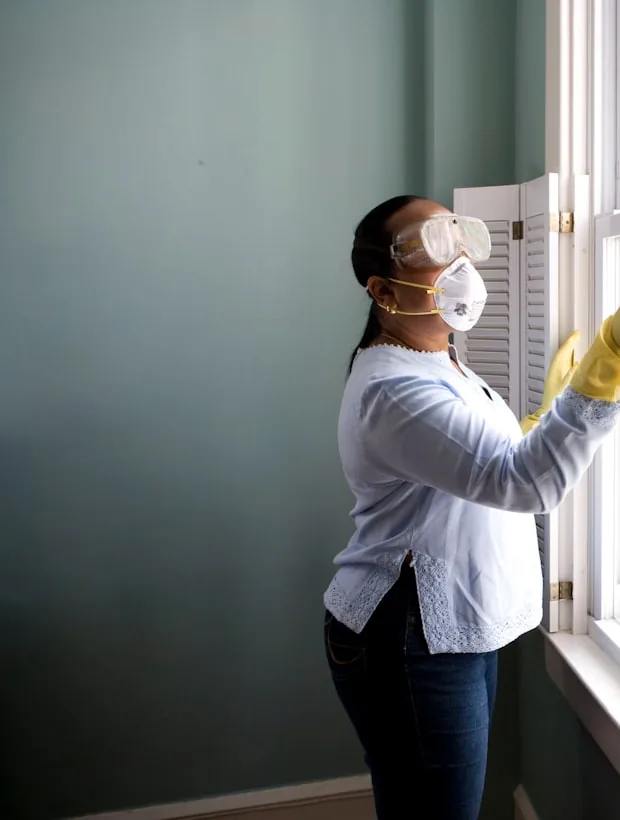
Cleaning interior glass without streaks
Streaks come from residue, not technique. Too much product, hard water drying on the glass, or a cloth contaminated with fabric softener will all streak no matter how well you work.
The method:
- Dust the frame, sill and track first. Otherwise you make mud
- Use a minimal amount of solution. Warm water with a few drops of washing-up liquid is genuinely as good as most branded sprays. A splash of white vinegar helps in hard water areas
- Wash the glass with a microfibre cloth or a small applicator, covering the whole pane including the edges
- Squeegee in a single continuous pass, wiping the blade after each stroke. Work top to bottom, overlapping slightly
- Detail the edges with a dry microfibre
- Buff with a second, completely dry cloth
Two things matter more than the rest. Never clean windows in direct sunlight, because the solution dries before you can remove it and leaves exactly the streaks you are trying to avoid. And never wash microfibre cloths with fabric softener, which coats the fibres and makes them smear permanently.
Frames, sills and tracks
Usually more visibly dirty than the glass and almost always skipped.
Vacuum the track with a crevice tool first, then use a damp cloth and an old toothbrush for the corners. UPVC frames respond well to a dedicated UPVC cleaner if they have yellowed, and to a light cream cleaner for stubborn marks, though test in a corner first.
Do the hinges and the drainage holes at the bottom of the frame, which block with debris and cause water to pool inside the frame and eventually leak inward.
Exterior windows
Ground floor you can do yourself with the same method, plus a hose to rinse first.
Above ground floor is where it becomes a genuine decision. Working at height from a ladder is the point at which domestic window cleaning stops being a chore and becomes a real risk. Falls from height remain one of the most common causes of serious injury in the UK, and a ladder on soft or uneven ground with someone reaching sideways is exactly the scenario that causes them.
This is the main argument for paying someone, and it is a better argument than the cleaning quality one.
Water-fed poles, and why the glass is left wet
Most professional window cleaners now use water-fed pole systems: purified water pumped up a telescopic pole to a brush head.
Purified water has had its dissolved minerals removed, so it dries without spotting. That is why the windows are left visibly wet and not dried afterwards. If your window cleaner leaves the glass wet, that is the system working as intended, not a job half done. It is the single most common misunderstanding customers have about the modern trade.
The advantages are real: no ladders, reach up to four storeys, frames and sills cleaned at the same time, and no need for access to your garden in most cases.
What it costs
| Property | Typical exterior clean |
|---|---|
| Terraced house | £12 to £20 |
| Semi-detached | £15 to £28 |
| Detached | £25 to £45 |
| Large detached | £40 to £70 |
| Flat, communal access | £10 to £20 |
| Conservatory roof | £30 to £80 |
| Solar panels | £40 to £120 |
Most window cleaners work on a four to eight week rota, and prices assume regularity. A one-off clean usually costs more, because the first clean of neglected glass takes considerably longer.
Interior cleaning is normally charged separately, often at a similar rate to the exterior, and needs someone in the property.
How often
| Setting | Exterior | Interior |
|---|---|---|
| Average suburban home | Every 6 to 8 weeks | 2 to 3 times a year |
| Near a main road | Every 4 weeks | 3 to 4 times a year |
| Coastal | Every 4 weeks | 3 times a year |
| Rural and sheltered | Every 8 to 12 weeks | Twice a year |
| Commercial frontage | Weekly to fortnightly | Monthly |
| Rental, between tenancies | Every changeover | Every changeover |
Salt air near the coast is the most aggressive factor, and it affects frames and hardware as much as glass, so hinges and locks need occasional attention too.
Specific problems
Hard water spotting. White marks that will not wipe off are mineral deposits. Treat as limescale with an acidic descaler, left to dwell, then rinse thoroughly. Prolonged deposits etch glass permanently, in which case a specialist glass restoration polish is the only option short of replacement.
Paint or plaster splashes. Soften with water, then remove with a blade at a shallow angle, always wet. Dry scraping puts permanent scratches in the pane, and toughened glass is particularly prone to scratching.
Condensation between panes. The seal on the double glazing unit has failed. No amount of cleaning reaches it, and the unit needs replacing.
Green algae on frames. Common on north-facing elevations. A dilute mould and mildew cleaner, left to dwell, then rinsed.
Bird droppings. Remove promptly, since they are acidic and etch glass and paintwork if left.
Sap and pollen. Warm soapy water usually handles it. Sap sometimes needs isopropyl alcohol.
Timing
Overcast, still days are ideal. Avoid direct sun, and avoid freezing conditions, where water freezes on the glass and cleaning solutions behave unpredictably.
For interior windows, late winter and early spring is the highest-value moment, because that is when daylight is scarce and any film on the glass costs you noticeably more of it. It is also the point at which the low sun makes the dirt visible, which is why windows always appear on spring cleaning lists.
Frequently asked questions
Why does my window cleaner leave the windows wet? Because purified water dries spot-free. It is how water-fed pole systems are designed to work.
Is vinegar good for windows? It helps in hard water areas by dealing with mineral film. Plain warm water with a drop of detergent handles most of the job.
Should I use newspaper? It works, but it is messy and modern microfibre is better. The traditional advantage was lint-free absorbency, which microfibre now provides more conveniently.
How do I clean high windows safely? From inside where the window opens inward, with an extendable pole, or by paying someone. Not from a ladder on uneven ground.
Do I need to clean windows in winter? Interior yes, because daylight is scarce. Exterior less often, and avoid freezing days.
What about conservatory roofs? Specialist work, usually £30 to £80, and not a DIY job because of the fall risk and the fragility of many roof panels.